


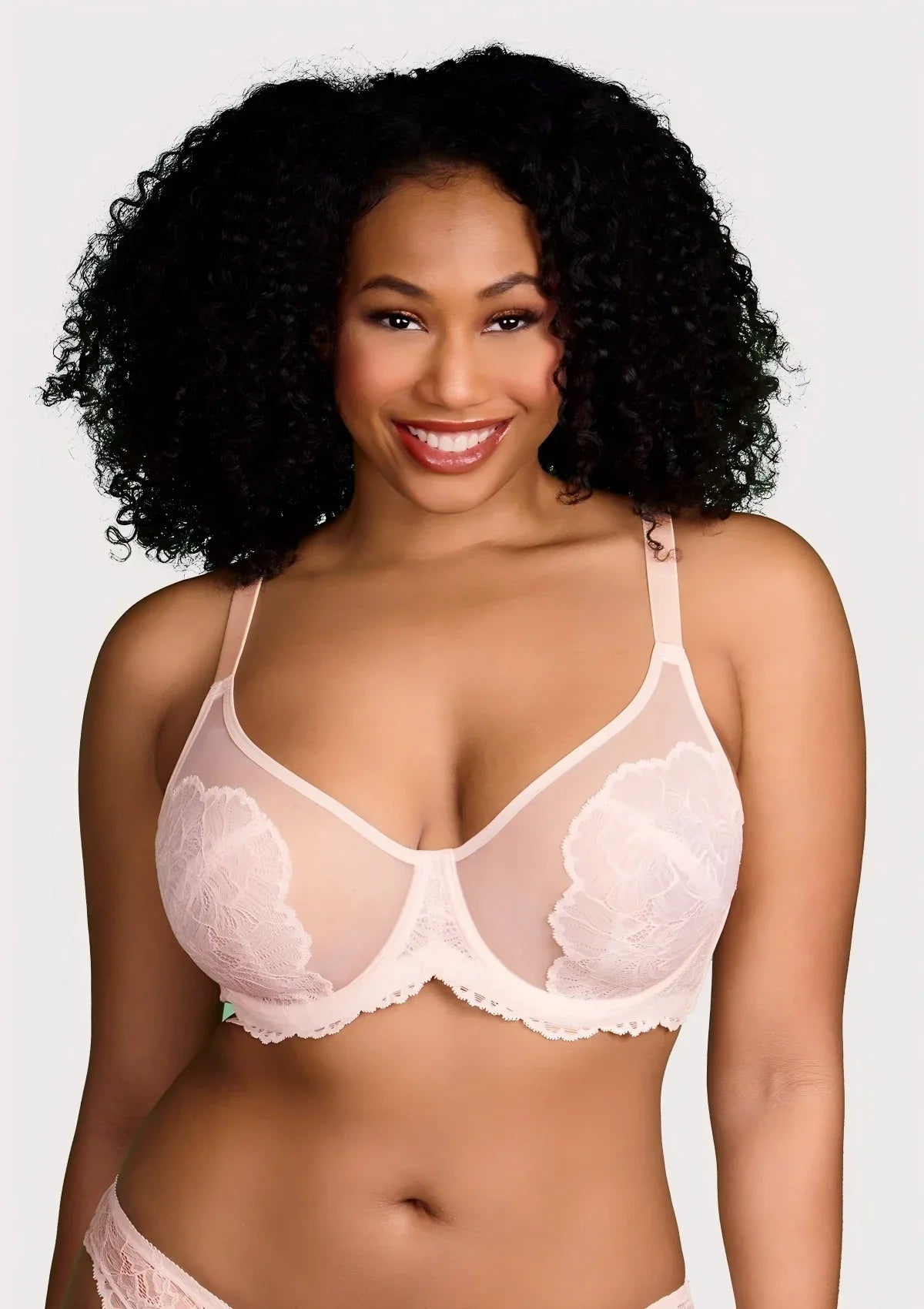


How to Choose the Best Side Support Bra for a Fuller Bust
|
|
Time to read 8 min
NEW Bras, Panties & Loungewear
Discount is automatic, no code required at checkout.
Only This Page
|
|
Time to read 8 min
The best side support bra has room for your bust, a stable band and side panels or slings that support the outer part of the cups. Start with fit, because side spillage usually traces back to cup room or cup shape before it points to a wider wing.
Perhaps your current bra fits around your ribs, but you keep adjusting the sides. Or your bust fills the outer cup while the top still gaps. Those details are your clues when you shop, and the answer is support in the right places.
Here's how to compare construction, make sense of common fit issues and choose between two HSIA styles with documented side-support features.
A good side support bra combines a suitable cup shape with a feature designed to support the outer bust. That feature may be a side panel built into the cup or a sling inside it. The band, straps and any underwire still need to fit comfortably.
Browse HSIA's side support bras and read what the construction actually is: “supportive” is the promise, while “built-in side panels” is the detail you can check.
Keep three questions in mind:
Side spillage is your cue to check cup capacity, band fit and wire placement together. Work through all three before you change your size or your style.
Start by settling your bust into the cups and adjusting the straps to a comfortable tension. Then look at where the bra sits and how it feels.
| What you notice | Check first | A useful next step |
|---|---|---|
| Fullness presses over the outer cup edge | Whether the cup contains your bust and the wire sits around it | Compare cup capacity and wire shape; consider another size or cut. |
| The outer cup feels crowded, but the top gaps | Cup height, depth and upper-edge shape | Try a different cup shape rather than automatically sizing down. |
| The band rides up when you move | Band size and strap tension | Recheck measurements and ease overly tight straps. |
| The side edge presses into your underarm | Cup height, wire length and wing height | Compare a cut with a more comfortable side profile. |
| The bra shifts or needs frequent adjusting | Band stability and how the whole cup fits | Reassess the complete fit before adding more coverage. |
These checks narrow your options, and more than one issue can appear at once. A cut that keeps feeling wrong is a cut to leave behind.
Cup-side support and the fabric wrapping around your torso do different jobs. Knowing where each feature sits makes product descriptions easier to compare.
| Feature | Where it sits | What it is designed to do |
|---|---|---|
| Side panel | At the outer part of the cup, integrated into its construction | Support the outer bust and help guide its appearance within the cup |
| Side sling | Inside the cup, along its outer side | Add targeted support from within the cup |
| Wing | Between the cup and the back fastening | Form part of the band around the torso; provide side coverage |
| Side boning, when present | Usually in a vertical channel in the wing | Help that area retain its shape |
| Underwire | Around the lower and outer cup boundary | Help define the cup's shape and support structure |
A bra with side support panels can also have wide wings, and the two often appear together. For an underwire side support bra, look for the side-support feature named in the description: “underwire” describes the wire, while the panel or sling is what supports the outer bust.
When a product photo shows the inside of the cup, take a close look. Let the description identify what you see, because a seam or a shadow of fabric can mean several things and the naming is what tells you it is a sling.
Try the bra under the actual top you plan to wear. Lace and seams read differently depending on the fabric, color and lighting. Side support describes construction, and the finished look under a top comes from the lace, the seams and the fit together.
For more on cup materials, our unlined bra guide explains the style in more detail. If your main concern is the band outline across your back, the back-smoothing guide for fuller busts addresses that separate fit and coverage question.
Blossom and Lira both carry named side-support features. Blossom builds in an additional side mesh panel; Lira uses built-in side panels alongside double-layer elastic mesh. Both are unpadded underwire styles, so the choice comes down to cup construction and the details you prefer.
| Detail | Blossom | Lira |
|---|---|---|
| Documented side-support feature | Additional side mesh panel | Built-in side panels |
| Cup construction | Unlined lace with underwire | Unpadded underwire cups with double-layer elastic mesh |
| Other listed details | U-shaped back | High center gore, U-shaped back and adjustable straps |
| Listed band options | 32–46 | 34–46 |
| Listed cup options | C–I | C–I |
| A good match when | You want unlined lace with a clearly described mesh side-support feature | You want built-in side panels in a minimizer style and prefer a higher center front |
| Check during try-on | Outer-cup fit, wire placement and lace under your usual tops | Center-front comfort, side-panel fit and fabric under your usual tops |
Blossom's band range starts at 32 and Lira's at 34, so a smaller ribcage has one more starting point in Blossom.
HSIA Blossom Unlined Lace Bra pairs underwire cups with an additional side mesh panel, a combination designed to support and lift the outer bust.
Its unlined lace cups suit you when you prefer a bra without foam padding. During a try-on, focus on whether the outer cup contains your bust comfortably and whether the wire follows the area around it without pressing into breast tissue.
Choose Blossom for unlined lace with a side mesh panel, and for the band range that starts at 32.
Under your tops: unlined lace brings texture, so try it with the knit or blouse you wear most and see how the lace reads in daylight.

HSIA Lira Unlined Minimizer Bra builds in side panels that direct the bust inward and upward for a slimmer profile. It also lists double-layer elastic mesh, unpadded underwire cups and a high center gore.
That makes Lira the one to compare when you want side support together with a minimizer silhouette. See how it reads under the clothes you wear most, which is where a minimizer shape shows.
Lira's adjustable strap widths vary with size, and the page lists 15–24 mm. When trying it on, check how the high center front feels alongside the outer cups, since center coverage is a preference you either love or you don't.
Choose Lira for built-in side panels, double-layer mesh and a high center front in an unpadded cup.
Neckline note: a high center front is the defining detail here, so pair it with the necklines you actually wear and keep your usual measured size. Minimizer refers to the silhouette the cup creates.

Once the bra is on, spend a few minutes moving normally. A good mirror view helps, and the fit has to work when you leave that pose too.
If you keep adjusting one area to fix another, compare a different size or cup shape. The goal is comfortable support you can get on with your day in.
Coverage and side-support construction are separate features, so pick a cup that contains your bust comfortably without unwanted upper-cup space or underarm pressure, then match it to the side-support detail you want.
Start with the fit issue you want to solve, then look for a structure that addresses it. When you are ready to compare more options, browse HSIA's side support collection with your measurements and preferred cup shape in mind.


